
 EN
EN ES
ES FR
FR DE
DE IT
IT PT
PT AR
AR JA
JAUsing Adjustable High Heel Display Risers to Improve Boutique Display
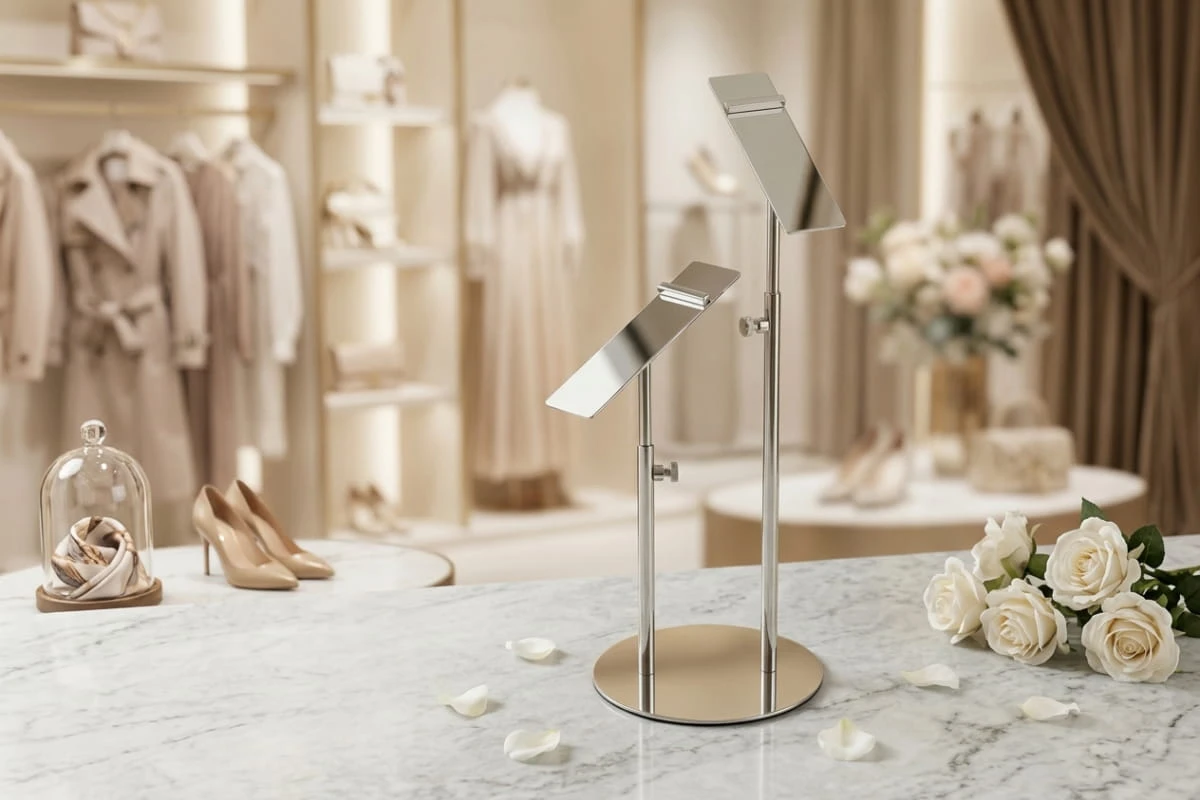
Displaying heels on a boutique counter is harder than it looks.
The issue isn’t the shoes themselves. It’s the height variation. A stiletto (5cm), a block heel (8cm), a platform (10cm), placed on the same counter: shoe faces at different heights, and the visual rhythm shifts.
Every morning, the first thing staff do is rearrange the shoes on the counter. There are many reasons: the style being featured today has changed, the season changed, new arrivals are out. But after they finish, they notice something odd: with different heel heights, every shoe at the same level looks uneven.
Boutique owners rarely use the phrase “height difference.” What they actually say is:
“My heels are all different heights, and they look messy together.”
But “messy” is a symptom of something else. A 5cm stiletto has its own visual language (understated commute-ready); a 10cm platform has its own visual language (a towering evening / cocktail look). When these characteristics get flattened onto the same level, the result looks messy.
Fixing “messy” isn’t about forcing every shoe to the same level. It’s about letting each heel height land where it fits, so the whole display has rhythm without looking chaotic.
A Few Considerations for Display Fixtures
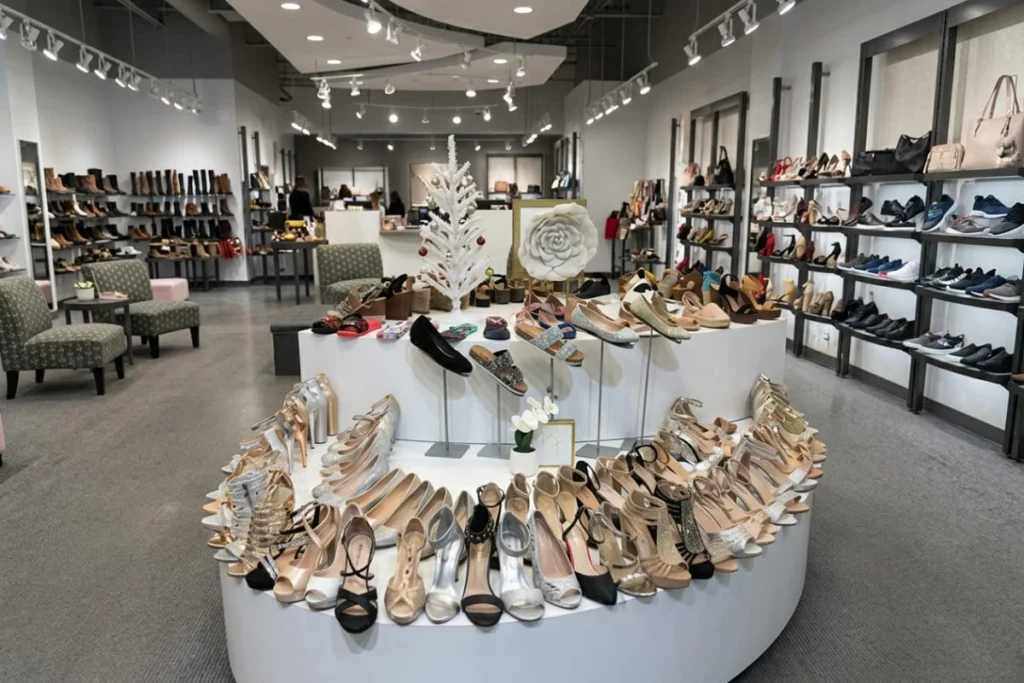
The material, finish, and placement of your display fixtures determine the first impression customers get when they walk in.
Acrylic is understated: clear acrylic lets the shoe take center stage, and the fixture itself almost disappears from view. Metal fixtures are different: the surface reflects light strongly, and when light hits it, it bounces back onto the shoe, making the shoe brighter.
Customers may not be able to articulate why a store “looks high-end,” but they can feel it. That feeling is half from the shoes themselves, half from the interplay between the display fixtures and the lighting.
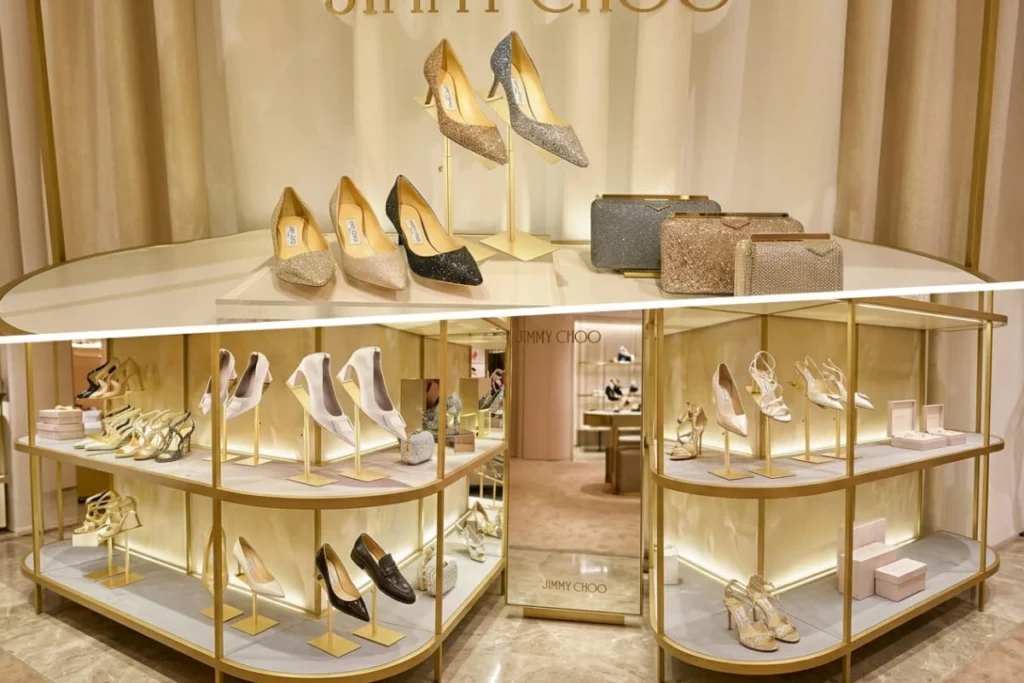
Finish choice depends on the lighting. Gold pairs with warm light; matte silver with neutral light; brass with slightly warm light; rose gold with cooler light. This isn’t a color choice. It’s lighting matching.
There’s an old saying in retail: VM (visual merchandising) is “silent selling.” Display fixtures aren’t decoration. Their job is to draw attention, set the mood, show the shoe in its “intended form,” and keep customers in the store.
The Display Challenges of a Boutique
Last autumn, Mireille Voss (name changed for privacy) reached out to us. She runs a women’s footwear boutique in London, has been at it for five years, and was preparing to open a second location with a fall collection to put on display.
For the fall collection, she had 12 SKUs across 3 heel heights:
- 5cm stiletto (daytime / commute)
- 8cm block heel (evening / date)
- 10cm platform (cocktail / formal)
The new collection was to land on the counter on opening day.
For the past five years, she had been using acrylic risers (cheap, lots of styles, unobtrusive). But there was a problem she struggled to put into words: in a street with abundant natural light, acrylic just doesn’t carry the restrained feel of a boutique. She had also tried having a carpenter build a set of wooden steps, but they took up too much space and felt visually heavy, clashing with her ‘minimalist and restrained’ brand.
So her needs were actually quite clear: a metal finish that matches her store’s tone, and a way to keep three different heel heights visually unified on one counter. She searched online, came across our site, and reached out by email.
Potential Needs
In our conversations, we realized there were a few needs she might have that she hadn’t thought to ask about.
Finishes Scratch Easily
Cheap metal risers. After staff handle them a few times a day, the surface starts showing fine scratches. What a boutique owner dreads most is the fixture starting to look like a market stall piece after a few months of use.
Low-priced metal fixtures show scratches within the first year because of subpar materials and workmanship. It’s an industry-wide problem.
Durability
Staff adjust displays constantly throughout the day, so the fixture’s durability matters: will screws loosen, will the finish wear down, will it still look the same six months in?
Cost Control
She assumed finish and logo would require custom molding. Then she found our catalog already had what she needed: single-shoe styles, pair-shoe styles, finishes in gold, matte silver, brass, and rose gold. Plus logos can be UV-printed onto the fixture, so no custom molding needed. Fits her budget.
Recommended Styles
After talking it through, we settled on a few styles that fit her needs.
Single-Shoe Styles
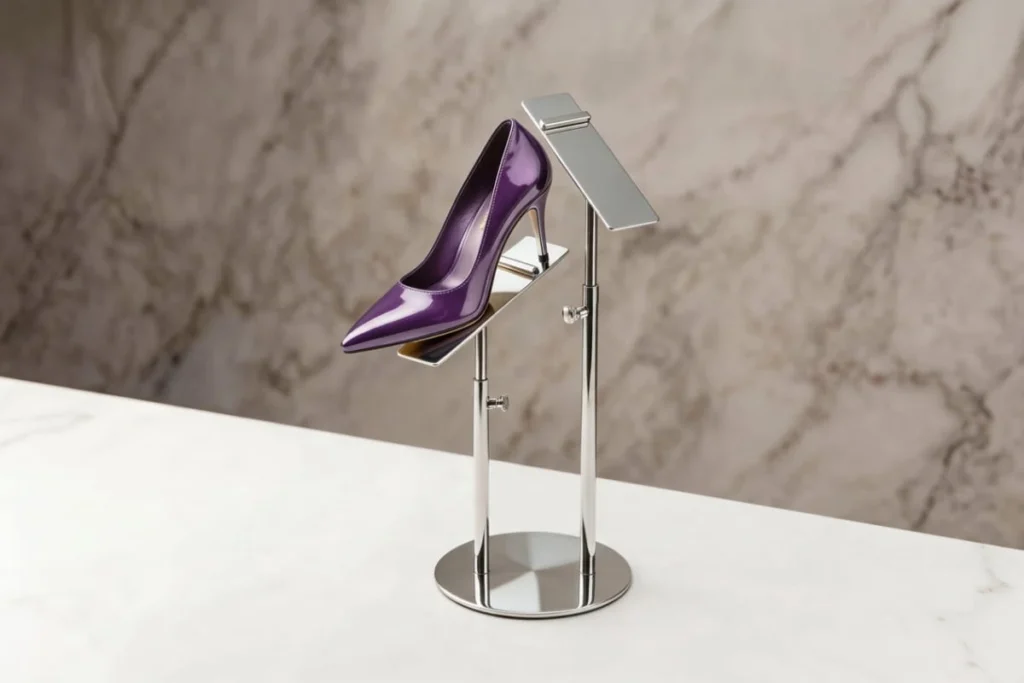
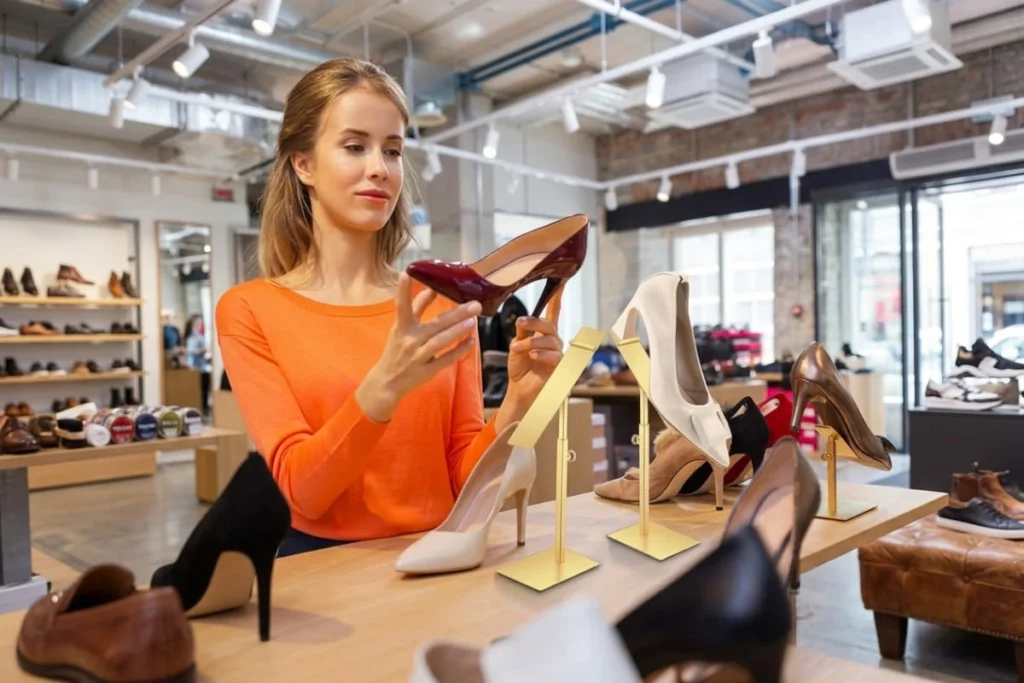
Ideal for 5cm stilettos: single-shoe display that lets the shoe’s silhouette read at a glance. Also works for window displays: the same shoe can be shown at different heights and angles.
- Height adjustable, so different heel heights form a rhythmic visual cascade
- Angle adjustable (level to tilted), adapting to different shoe uppers
- Heel stop to prevent slipping
- EVA pad on the base, won’t scratch the counter
Pair-Shoe Styles
Ideal for 10cm platforms: pair display. Most commonly used on the sales floor.
- Short version 8.5″–11.8″, tall version 9.8″–17.1″, creating a tiered, rhythmic cascade
- Visual merchandising has the “Rule of Three”: three different heights catch the eye more than a flat arrangement
Construction
These styles can carry a boutique’s quality because of how they’re built. Laser-cut + argon-arc welded, structurally solid; hand-polished for an even finish; screws allow 360° rotation and free height adjustment, holding up after repeated adjustments. Finishes available: gold, matte, rose gold, brass, copper, stainless steel.
Window Display Use
Beyond the sales floor, window displays are another common use case. A featured piece in the window can be shown at different heights and angles: close-up views of the silhouette, distant views of the whole shoe. That gives you far more flexibility than a fixed-height fixture.
Why Adjustable Height Matters
Back to the original question: how do you display shoes of different heel heights on the same counter?
The core value of an adjustable-height fixture is letting different heel heights form a visual cascade rather than a visual mismatch. A fixed-height fixture puts every shoe at the same level. The arrangement looks tidy, but you lose each shoe’s visual character. Adjustable height means a 5cm stiletto can sit slightly lower (understated commute-ready) while a 10cm platform can sit higher (towering impact), giving the whole display rhythm without chaos.
In a window display, the value of adjustability becomes even clearer. A featured shoe in the window can be shown at different heights and angles: close-up of the silhouette, distant view of the whole shoe. That gives far more flexibility than a fixed-height fixture.
Metal finish gives the shoe a more refined look; adjustable height lets different heel heights form a controlled visual cascade; welded construction holds up to repeated adjustments. These three craft details are why metal fixtures get picked for high-end displays. Acrylic and wood each have their own strengths. They’re just suited to different scenarios.
Final
Opening a new boutique, putting new arrivals on display, or just looking for a better display setup: you can browse our shoe display series first. Get in touch, and we’ll design the most fitting display solution for you.
References
Bell, G., & Ternus, J. (2017). Silent Selling: Best Practices and Effective Strategies in Visual Merchandising.