
 EN
 ES
 FR
 DE
 IT
 PT
 AR
 JA
How to Evaluate the Quality of Acrylic Displays

Every supplier of acrylic displays says the same thing: quality material, clean finish, competitive price. For a buyer sourcing for a brand or a chain, the useful question is how to tell one sheet, or one finished display, from another without a lab. Most of what separates a display that still looks right after two years from one that yellowed, warped, or cracked comes down to a handful of things you can check by eye, by hand, and with a caliper.
This guide walks through them, starting with the decision that matters most: whether the sheet is cast or extruded.
Cast or Extruded: The First Question
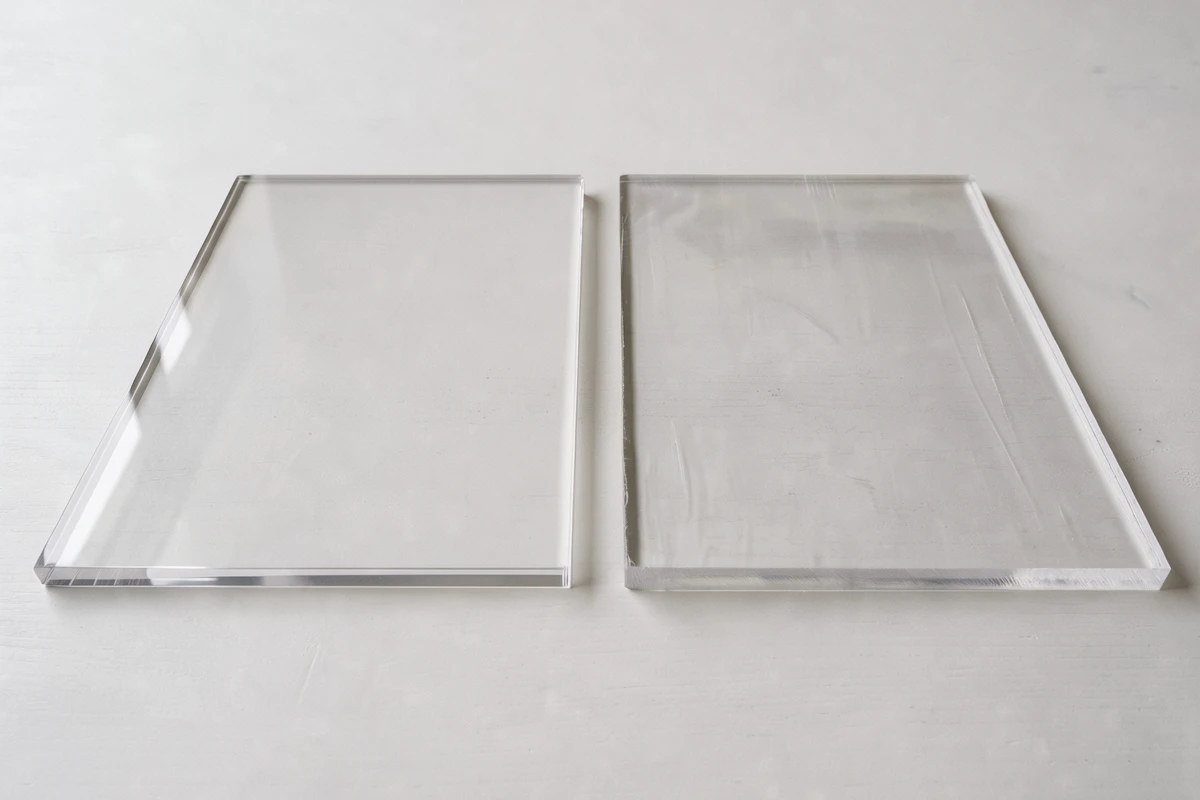
PMMA, the plastic sold as acrylic, plexiglass, or Perspex, comes as two kinds of sheet, and they are not equivalent. Cast sheet is made by pouring monomer into glass molds and polymerizing it over a period that runs from a few hours to days, depending on thickness. Extruded sheet is produced continuously and only became common in the late 1970s. On quality, the technical literature is direct: extruded sheets are of poorer quality than cast sheets (Babo et al., 2020).
The difference is measurable, not just reputational. A comparison of cast and extruded PMMA plates found the two behave differently in optical transparency, in the surface finish left by laser cutting, and in how they shrink: cast sheet shrinks evenly, at around 1.8%, while extruded sheet shrinks unevenly, about 0.4% in one direction against 1.5% in the other (Fan et al., 2026).
For display work that means two practical rules. Where clarity and a clean cut edge carry the piece, specify cast. And do not let one program mix cast and extruded parts, because the difference in shrinkage shows up later as components that no longer fit the way the sample did.
Clarity, Haze, and Color Cast
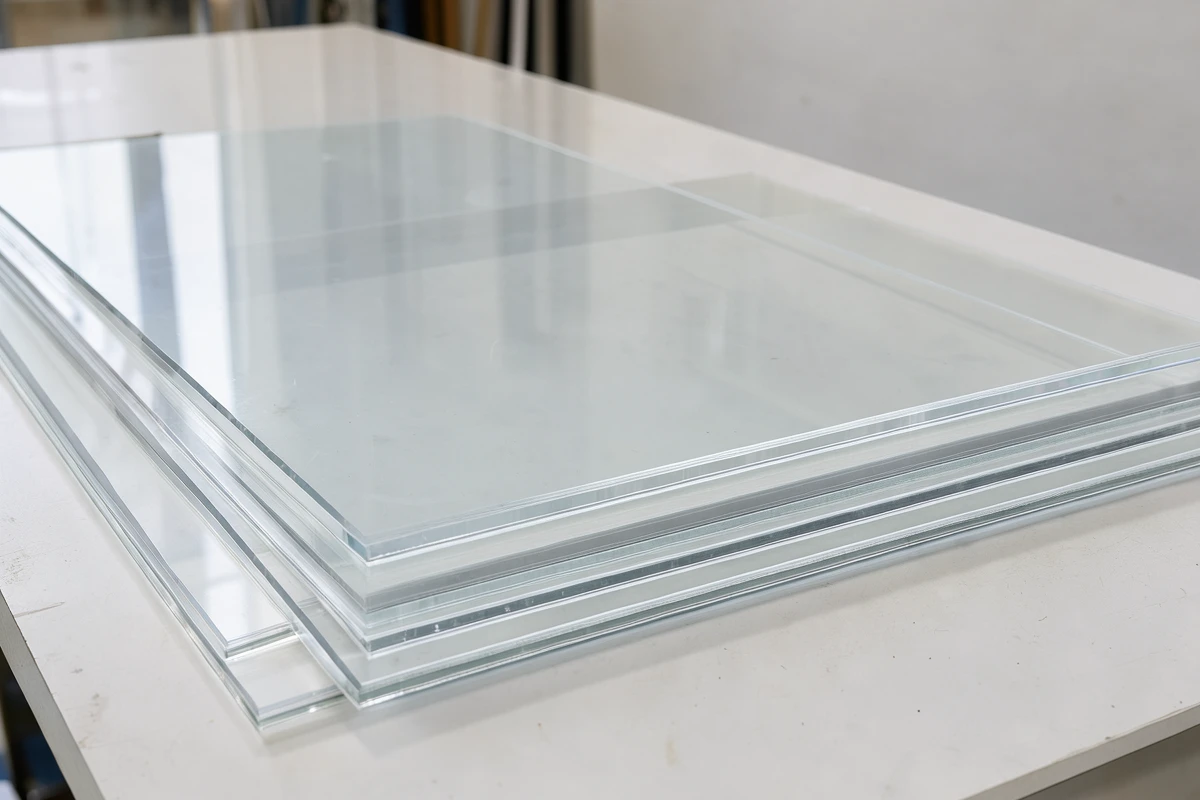
Quality acrylic is close to glass in clarity. A good sheet transmits about 92% of visible light (Fu et al., 2018), and it does so neutrally. Check the sheet rather than the brochure: hold it against a white surface, or pass a white light through it. A good clear sheet stays white and neutral. A yellow or blue cast means the material or the process is off, and it will read as cheap under store lighting.
Then look for what should not be there. Bubbles, black specks, and a hazy, milky face are defects. Haze is the enemy of a display meant to disappear behind the product, and it cannot be polished out. The face and the edge both matter, since a display’s edge is often the part a customer sees first.
Thickness and Tolerance
Acrylic thickness is nominal, not exact, and the tolerance is where suppliers cut corners. A sheet sold as 5mm can arrive at 4.6mm, and the thinner material saves the maker money while costing the buyer stiffness and a solid feel. Measure with calipers at several points across the sheet, not just the corner, and check that the thickness holds. Where a program will be reordered, ask what tolerance the supplier holds to and put it in writing. Consistency across a sheet matters as much as the number at any single point.
Edges, Surface, and Feel
A finished acrylic display is judged by its edges. A quality edge is polished and clear, with no burrs, chips, or dull white machining marks. Run a finger along it. Sharp or rough edges mean the fabricator skipped the finishing step, and on a display handled by staff and customers, they are also a safety issue.
The surface should be smooth and even. On gloss material, look for scratches, pits, and swirl marks; on matte or frosted material, check that the texture is uniform and without patches. Touch the sheet and watch what the fingers leave behind. Good acrylic does not hold fingerprints and smudges the way a softer, cheaper sheet does.
Rigidity and Load
Hardness is where the raw material and the process show up together. The same display, made from a good cast sheet and a cheap one, can look identical on arrival and behave differently under load. Test it the way the store will: put the expected weight on the shelf or tray and watch for flex, bowing, or a surface that does not return flat. A display that deforms under a normal load will not hold its shape through a season of use.
Batch Consistency
For a single store, one good display is enough. For a chain, the standard is whether the tenth store’s display matches the first. Color and thickness have to repeat across batches, and the sheet type has to stay the same. The shrinkage and transparency differences between cast and extruded are exactly why a supplier that switches sheet types between orders causes problems nobody sees until installation. Ask how batches are tracked, and keep the approved sample as the reference for every reorder.
A Quick Inspection Checklist
| What to check | Good sign | Warning sign |
|---|---|---|
| Sheet type | Cast where clarity matters, held constant | Unlabeled, or switched between orders |
| Light transmission | About 92%, neutral | Yellow or blue cast |
| Surface | Clear, no bubbles, scratches, or pits | Haze, specks, uneven texture |
| Thickness | Meets nominal, consistent across the sheet | Under nominal, varies |
| Edges | Polished, no burrs or chips | Rough, dull, or sharp |
| Rigidity | Holds shape under load | Flexes or stays bowed |
| Batch match | Color and thickness repeat | Shifts between reorders |
Getting Quality Into the Order
Most of these checks are cheap to run and easy to write into a purchase order: sheet type, thickness with its tolerance, an approved sample, and a batch record. That is the difference between buying displays and buying the same displays twice.
SOONXIN produces acrylic displays across its jewelry display and cosmetics lines, organizers, logo blocks, and sign holders, selecting sheet type per part and holding color and thickness across reorders. Send us the piece you have in mind and the standard it has to meet, and we will quote the material and tolerance that get it there.
References
Babo, S., Ferreira, J. L., Ramos, A. M., Micheluz, A., Pamplona, M., Casimiro, M. H., Ferreira, L. M., & Melo, M. J. (2020). Characterization and long-term stability of historical PMMA: Impact of additives and acrylic sheet industrial production processes. Polymers, 12(10), 2198.
Fan, Y., Ding, S., Zhang, S., Han, W., Wang, Y., & Zhang, J. (2026). Comparison of casted and extruded PMMA plate used in microfluidics. Journal of Micromechanics and Microengineering, 36(8), 085007.
Fu, X., Zhang, G., Zhang, J., Guo, K., & Pan, Y. (2018). Improvement of aluminium film adhesion on PMMA using pre-layer and specific annealing. Coatings, 8(5), 186.