
 EN
EN ES
ES FR
FR DE
DE IT
IT PT
PT AR
AR JA
JAHow Rolling Poster Stands Improve Trade Show Setup Efficiency
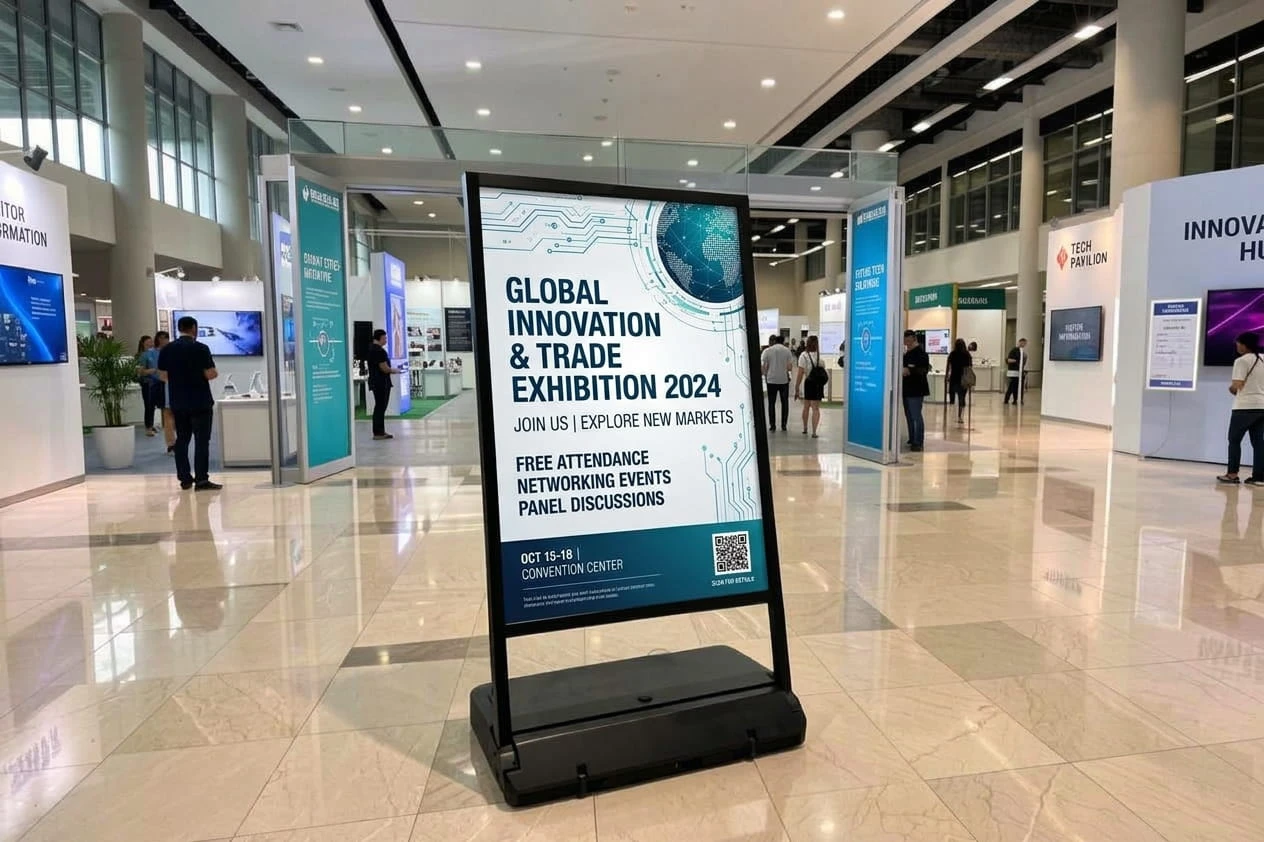
Trade show setup is a race against the clock.
Setup windows are typically just one to two days, and teardown is even shorter—sometimes only a few hours. Teams must complete the entire process from installation to teardown with limited manpower, all while handling countless last-minute adjustments. This is the daily reality of trade show setup.
The problem is this: demand for flexible deployment is growing stronger on the show floor, yet traditional display equipment’s bulkiness and instability have never been fundamentally solved. Lightweight signs tip over at a push. Sturdy metal frames can’t be moved by one person. Display equipment that moves quickly often can’t stay put, while equipment that stays put is as difficult to move as hauling a block of iron.
Is there a display fixture that can meet both conditions: quick mobile deployment AND stability on the show floor?
This is the question we get asked most often.
Challenges with Trade Show Poster Stands
Take Crestline Group (name changed for privacy) as an example.
This company executes over 200 trade shows per year. Their equipment is moved four to eight times per month—an exceptionally high frequency of use in the industry.
This is where the problems started to surface.
Difficult to Move
Heavy steel-base frames are stable alright, but every time they need to be moved from one booth to another, two people are required to lift them up and down. One person can’t do it alone; they have to wait for a teammate. In time-constrained setup windows, this is a hidden cost.
Casters Break Easily
After a few months of use, competitor sign stands develop loose wheels that squeak when pushed. The locking mechanism also wears out easily—a locked wheel will still slowly slide across the floor. The result is signs toppling over at the venue, causing unnecessary trouble for the event.
Easily Toppled by Wind
Entrance areas and corridor sections of exhibition halls have air conditioning vents and door seam drafts. Lightweight signs placed in these locations tilt over when a gust hits. This problem is especially pronounced in large exhibition halls, where HVAC systems run at higher power and air circulation patterns are more complex. Setup crews sometimes have to assign a dedicated person to hold the sign in place for ten minutes before they can leave.
Altogether, every trade show felt like dealing with a set of predictable headaches.
The SOONXIN Solution
After multiple equipment issues, Crestline Group’s manager reached out to us.
He said their previous suppliers either had products that were too heavy, or quality that couldn’t withstand high-frequency use. They needed a display fixture that could genuinely address these pain points, suitable for long-term rental use—something that wouldn’t break down after a few months.
So we recommended a few poster stands from our catalog, designed for both indoor and outdoor display use.
The core design philosophy of these rolling poster stands is straightforward: make the equipment light enough to move when needed, yet stable enough to stay put when fixed.
Weighted Base: Stable Against Wind and Drafts
In the North American trade show market, weighted steel bases have gradually become the preferred solution over water-filled bases, because the latter incurs much higher maintenance costs in frequent assembly and disassembly scenarios.
The base uses weighted steel construction, making it better suited for high-frequency moving than traditional water-filled bases. Water-filled bases have a natural flaw: the bladder material degrades over time and can leak, water freezes in cold winter temperatures, and every move requires draining before transport and refilling afterward—a cumbersome process. Steel weighted bases avoid all these issues, and can be stacked directly when stored, taking up no extra warehouse space.
More importantly, the weighted base directly determines wind resistance. The heavier the base, the more stable the sign will be at hall entrances and corridor areas. Exhibition halls typically don’t allow drilling into floors to secure displays, so self-stability is the only guarantee. Square bases are harder to topple than round bases—because when struck, a square base won’t roll the way a round one does.
Locking Casters: Roll It Where You Need It, Lock It in Place
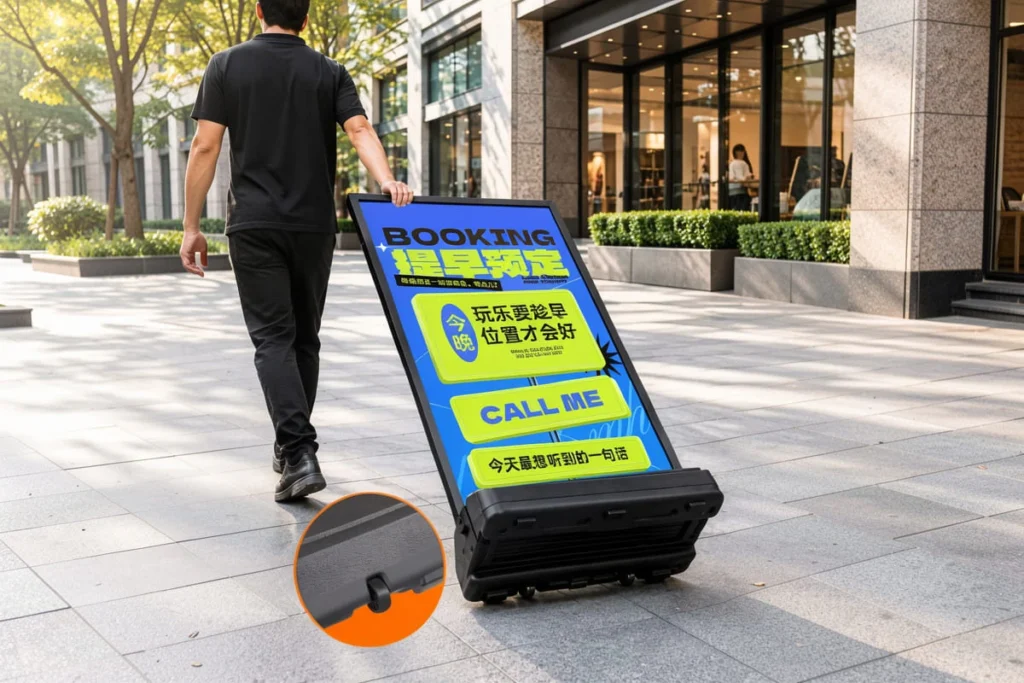
The wheels feature a dual-lock mechanism. The wheel lock prevents the wheel from rolling, and the swivel lock prevents the wheel from rotating. With both locks engaged, the wheel can neither roll nor pivot—the sign is locked in place.
This solves a specific problem: with ordinary wheels, signs would still slowly slide on the floor even when locked, especially on smooth tile surfaces. The dual-lock mechanism makes “roll it where you need it, lock it in place” a reality—one person can complete the entire process independently without waiting for a teammate.
Single-Person Operation: More Than Just Saving Two People
One person can complete the entire process from pushing to positioning. This means no waiting for a second person to coordinate, no scrambling for hands during a tight setup window. At Chicago labor rates of $25–$35 per hour, each event can save $50–$70 in setup costs. Multiply that across 200 events per year, and the figure becomes substantial.
The wheels themselves use ball bearing design for smooth 360° rotation and effortless pushing. The frame is aluminum alloy—lighter than steel yet strong enough for daily trade show use. Combined with a 30 lb weighted steel base, the unit stays planted at hall entrances and corridor areas without any additional ballast. The display surface supports posters and foam boards up to 15 lbs—more than enough for large-format trade show signage.
What Changed on the Show Floor
After switching to these rolling poster stands, Crestline Group’s setup team no longer had to worry about signs.
At every event before, sign toppling, wheel loosening, waiting for a teammate—all were expected headaches. The team had to reserve time and manpower specifically to deal with these issues. Now none of that exists: one person pushes the sign into position, locks the wheels, and walks away. No draft at the entrance will tip the sign over. After two years of use, the wheels are still steady with no squeaky-wheel embarrassment.
The setup window’s labor allocation can finally be optimized. Last-minute additions can be handled more easily.
Crestline Group’s manager put it simply: “We finally don’t have to apologize for signs falling over at the venue anymore.”
Simple words, but behind them are countless customer complaints and explanations from the setup crew. Countless instances of last-minute labor calls in tight setup windows just to steady a sign. Every instance of damaged reputation and the remediation that followed.
These rolling poster stands solve the core pain points of high-frequency use scenarios. They’re not the lightest, nor the cheapest—but they deliver on the two most critical dimensions: mobility and stability. For service providers executing 200 events per year, these two factors directly determine operational efficiency and customer reputation.
Purchasing Recommendations
If you’re evaluating this type of product, here are a few dimensions to consider:
Caster Locking Mechanism: Prioritize dual-lock designs with both a wheel lock and a swivel lock. Single-lock structures are more likely to experience “locked but still sliding” on smooth floors.
Base Type: Steel weighted bases are better suited for high-frequency assembly and disassembly than water-filled bases. Though the initial purchase cost is slightly higher, it eliminates the need for draining and refilling each time, making the long-term total cost of ownership lower.
Frame Weight-to-Capacity Ratio: Aluminum alloy frames offer a good balance between weight and strength. If the equipment needs to be moved frequently, the frame weight is a factor you can’t ignore.
Base Shape: Square bases outperform round bases in topple resistance—they don’t roll when bumped, which can immediately reduce damage.
Final
Time pressure in trade show setup will only continue to intensify. Last-minute orders and quick adjustments will be the norm, not the exception. Equipment flexibility determines whether a team can keep up with this pace.
If you’re also struggling with the contradiction between portability and stability in display equipment, check out our poster stand product page. Or reach out to us directly for a customized solution that fits your actual needs.
References
Trade Show Statistics 2026: Data Every Exhibitor Needs – Pure Exhibits (Data sources: CEIR, IAEE, Exhibitor Magazine, Freeman Research, Exhibit Surveys Inc.)