
 EN
EN ES
ES FR
FR DE
DE IT
IT PT
PT AR
AR JA
JA4 Methods for Printing on Acrylic and When to Use Each One
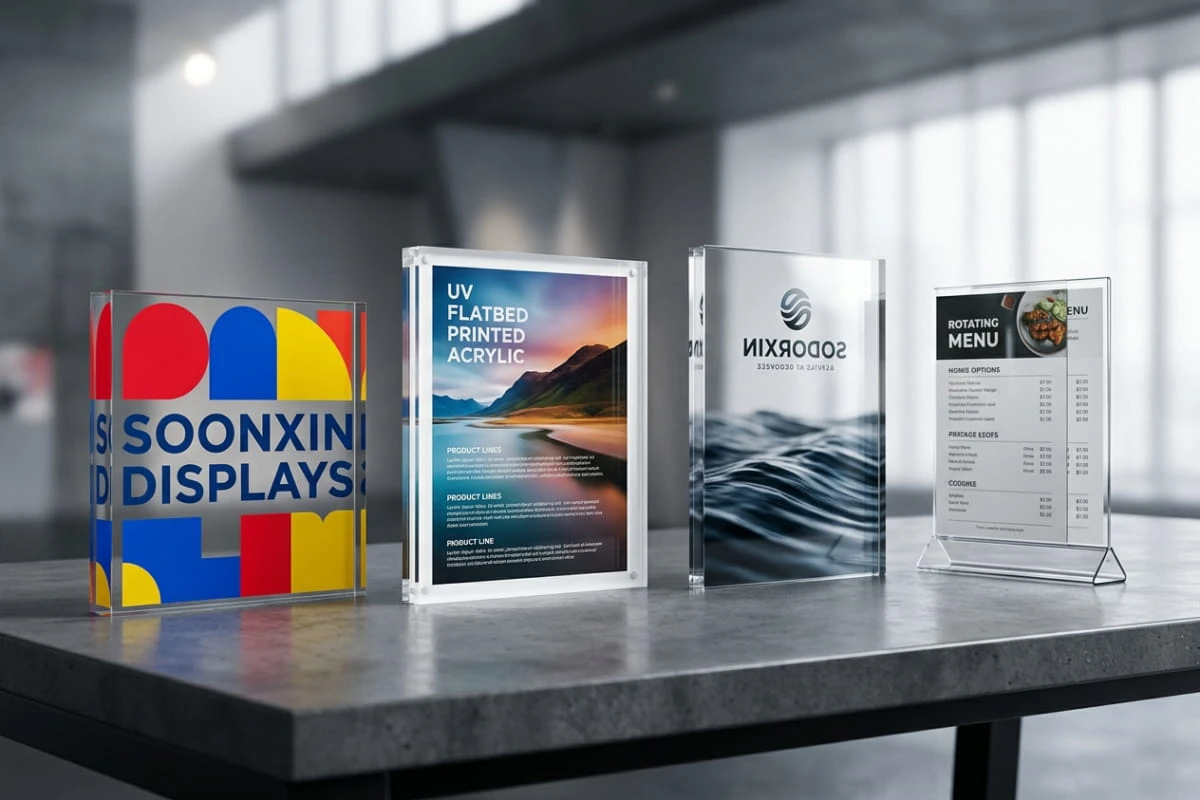
The same material travels under several names. Acrylic, plexiglass, Perspex, PMMA sheet: they all describe the same clear, rigid plastic that retails signs, logo blocks, and display cases are made from. The printing question behind all of it is the same one buyers ask us: which method should my acrylic pieces be printed with?
Four methods do most of the work on display and signage acrylic: screen printing, UV flatbed printing, reverse printing on the back of the sheet, and printed inserts that sit behind the acrylic. They are not interchangeable. Each has a quantity, an artwork type, and a handling condition where it clearly beats the others, and picking the wrong one shows up either in the unit price or in how the print wears.
1. Screen Printing on Acrylic: Solid Colour at Volume
Screen printing is the oldest process on this list and still the default for straightforward logo work. Every colour gets its own mesh screen, with the design burned into it, and a squeegee presses ink through the open areas of the mesh onto the acrylic surface. One pass per colour.
What makes it the volume favourite:
- The ink sits on the surface in a thick, opaque film, so a solid colour stays dense and even on clear acrylic, where thin ink layers would look washed out.
- Once the screens exist, each additional piece costs very little. Colour registration is stable from the first piece of a run to the ten thousandth.
- Metallic inks, gold and silver in particular, print well through a screen and are hard to reproduce by other means on acrylic.
That dense, even coverage is built into the process rather than left to press settings. Studies of how screen printing deposits ink found the final film thickness changes little with press variables and is governed mainly by the geometry of the mesh itself, thread count and diameter above all (Dolden, 2005).
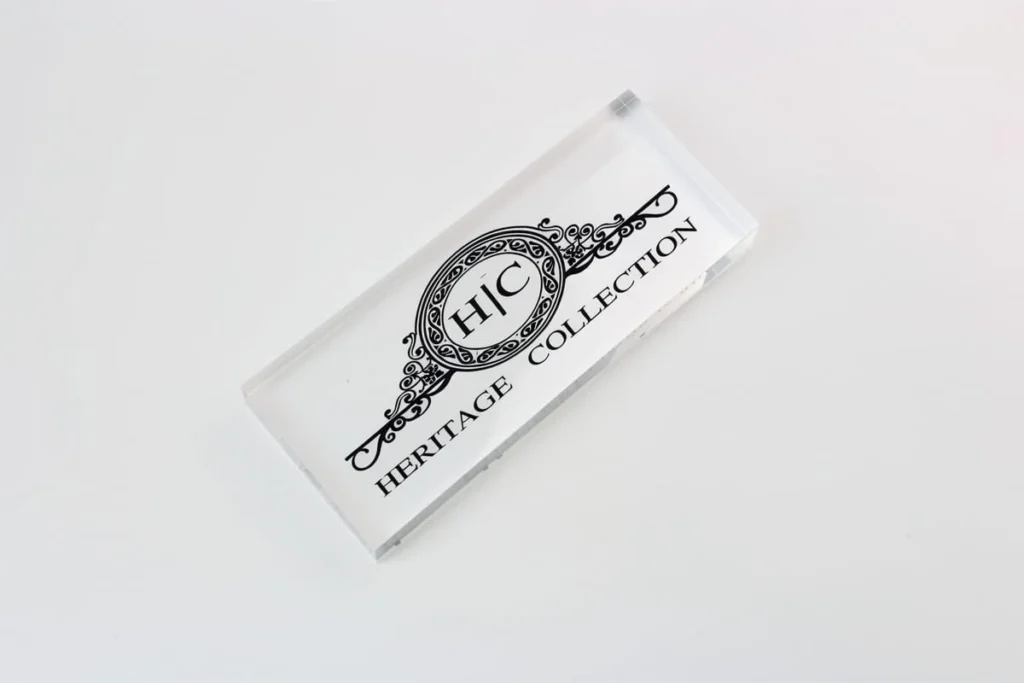
The trade-off sits in setup. Every colour in your logo is a separate screen, and every new screen costs time and tooling before a single piece is printed. That economy works in one direction: a two-colour logo across three hundred logo blocks prices out well. A photo or a gradient cannot be held by a mesh stencil in the first place, so complex artwork goes to a different method.
Screen printing suits fixed brand colours on permanent fixtures: logo blocks, counter signs, sign holders, and the printed faces of retail display stands where the design will not change for years.
2. UV Flatbed Printing on Acrylic: Detail, White Ink, and Short Runs
UV printing uses an inkjet head that lays ink directly onto the sheet, and lamps mounted beside the head cure the ink the moment it lands. There is no drying stage. The sheet comes off the bed ready to inspect, cut, or pack, which is also what makes small batches practical: the machine prints straight from your design file with no screen tooling at all.
Because the ink never soaks in or runs while still wet, the process holds fine edges and smooth gradients. Photos, full-colour graphics, and multi-SKU sets that would be absurd to screen print can go on in a single run, and one-off samples cost little more than production pieces.
White ink changes what clear acrylic can carry. Printed alone, most inks look pale and glassy on clear sheet because light passes straight through them. A white layer under the colour brings it back to full strength. The printer builds this in layers, and the layer order depends on where the print sits: white under colour for a front-facing print, colour printed mirrored with white behind it when the design will be read through the sheet, and more elaborate sequences for graphics meant to show from both sides. Text has its own sequence, since lettering read through a clear substrate mirrors easily. RIP software handles these layer orders automatically, but it matters to a buyer anyway: confirm the print sequence with your supplier before artwork gets locked, ask which mode they have planned for your design. Catching it late is the most common reason a proof comes back with lettering facing the wrong way.
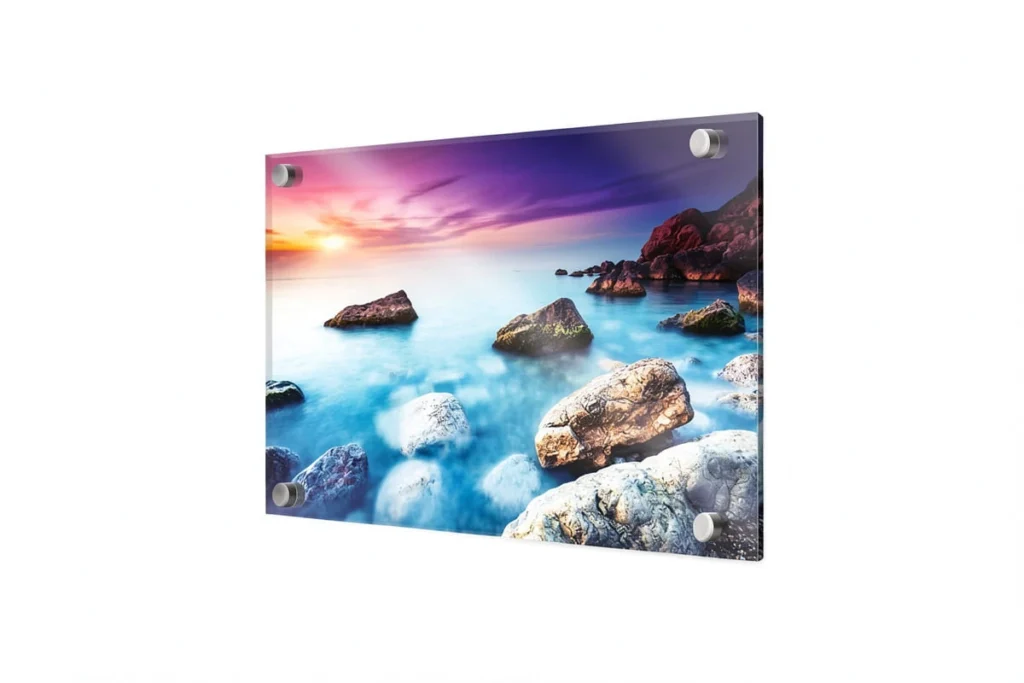
Two more things UV printing adds. A gloss varnish pass can sit on top to give raised, tactile detail to a logo or pattern, and cured UV ink resists water and fading, so it holds up in outdoor-facing work.
Against screen printing, its weakness is arithmetic: at high volumes of simple, one or two colour artwork, per-colour screens amortise better than per-piece inkjet passes. UV is the detail method, not the cheap-at-scale one. It also has a materials caveat: untreated PMMA is a low-surface-energy plastic, and ink sits on it rather than in it. Surface treatment such as plasma activation measurably raises ink adhesion on PMMA, which is why surface preparation is treated as a QC step at any serious print shop (Fleischer et al., 2024). For buyers, the takeaway is simpler: ask whether sheets are pre-treated before printing, especially for outdoor-facing or frequently handled pieces.
3. Reverse Printing: The Print on the Back of the Sheet
Reverse printing, printers call it second-surface printing, means the artwork prints mirrored onto the back face of the sheet and is read through the acrylic itself.
Two reasons to put a print there instead of on the front:
- The ink ends up behind solid acrylic, so fingers, cleaning cloths, and liquids never touch it. For counter signs and menu holders, pieces that get wiped dozens of times a day, front prints wear first. A second-surface print doesn’t.
- Clear sheet over the print adds depth. The artwork looks embedded in the material rather than sitting on it, which is what gives a good acrylic sign its glass-like feel.
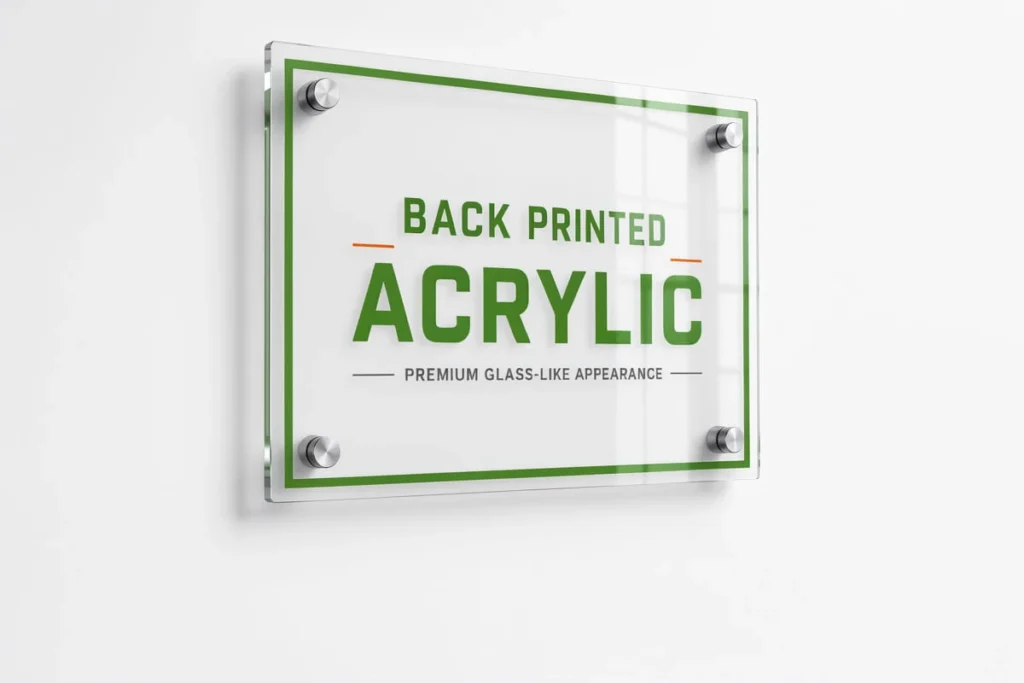
Both screen printing and UV printing can be done this way. The cost of the choice is technical, and buyers should know it before artwork is finalised: the design file must be mirrored, colour layers get planned against how light passes the sheet, and front-surface effects like raised varnish sit differently when the print faces inward. Flat, even artwork suits second surface best; textured surfaces want a front print.
4. Printed Inserts: Graphics Behind the Acrylic Rather Than On It
The fourth method stops short of printing on the acrylic at all. A sign holder is usually an acrylic frame holding a printed card, and that card can be replaced with a new print at any time. The same logic extends to film: printed film faces go into lightbox panels, and thin vinyl can carry a photo print mounted behind clear sheet.
It earns its place on the list for display work in two situations:
- The graphics change. Seasonal promotions, rotating menus, price cards that get reprinted per campaign all make more sense printed on paper or film at a fraction of the cost, instead of locking the same graphic into the fixture.
- The print is very large. Big backlit panels and store-wide campaigns are printed on film and mounted, since printing directly onto a full-size acrylic sheet at print quality is awkward and expensive.
The trade-off is assembly and edges. An insert is one more part to make, and the film edge can catch light where a direct print has none. It is the wrong tool for a permanent brand logo; it is the right one for anything a store will want to change without buying a new fixture to change it.
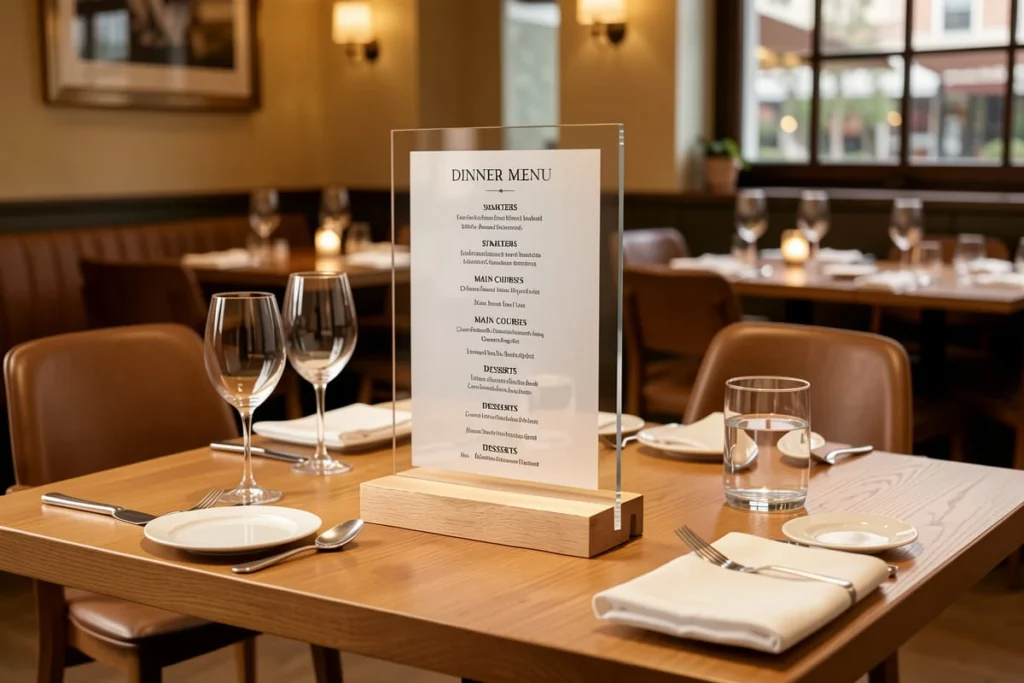
Acrylic itself earns its reputation as the stable carrier in all of this. PMMA ages slowly compared with most clear plastics: in accelerated weathering studies, cast acrylic sheet held its transparency over thousands of hours, and where degradation appeared it stayed largely in the surface layer (Babo et al., 2020). Strong sunlight is still worth planning around, since UV-B exposure trials show untreated PMMA yellows and loses transparency over long exposures (Monsores et al., 2019), which is one reason outdoor-facing pieces are specified on UV-stabilised sheet. That stability is why a print method chosen properly will usually outlast the store fit-out around it.
Choosing by Order Profile
No method wins everywhere, and most quotation conversations come down to three questions: what the artwork contains, how many pieces you need, and how the printed surface will be treated after delivery.
| Screen | UV flatbed | Reverse print | Insert | |
|---|---|---|---|---|
| Suits | One or two solid colours | Photos, gradients, fine detail | Flat graphics on clear sheet | Artwork that gets replaced |
| Typical quantity | Large runs | Small batches to mid-size | Any, matching the base method | Any, print cost is in the card |
| Look | Dense opaque solids, metallics | Sharp detail, white ink, raised varnish | Embedded, protected look | Depends on the printed card |
| Watch out for | Per-colour tooling on short runs | Higher unit cost at volume | Artwork must be mirrored | Extra part and visible edges |
Have your artwork files ready before you ask for quotes. Vector files for logos and text, and print-resolution files around 300 dpi where photographs are involved. Ask each supplier two questions: which method they plan to use, and which side of the sheet the ink goes on. The second question decides how the piece will look after a year on a shop counter.
SOONXIN manufactures custom acrylic display fixtures, from logo blocks and sign holders to organizers, display cases, and full retail display programs. Acrylic pieces are finished with UV printing, screen printing, and laser engraving, selected per piece to match artwork and use. Send us what your brand needs printed and where it will be used, and we will tell you which method fits and what it costs.
References
Babo, S., Ferreira, J. L., Ramos, A. M., Micheluz, A., Pamplona, M., Casimiro, M. H., Ferreira, L. M., & Melo, M. J. (2020). Characterization and long-term stability of historical PMMA: Impact of additives and acrylic sheet industrial production processes. Polymers, 12(10), 2198.
Dolden, E. D. (2005). Fundamental investigations into screen printing. PhD thesis, University of Leeds.
Fleischer, M., Kelar Tučeková, Z., Galmiz, O., Baťková, E., Plšek, T., Kolářová, T., Kováčik, D., & Kelar, J. (2024). Plasma treatment of large-area polymer substrates for the enhanced adhesion of UV-digital printing. Nanomaterials, 14(5), 426.
Monsores, K. G. C., Silva, A. O. da, Oliveira, S. de S. A., Rodrigues, J. G. P., & Weber, R. P. (2019). Influence of ultraviolet radiation on polymethylmethacrylate (PMMA). Journal of Materials Research and Technology, 8(5), 3713 to 3718.