
 EN
 ES
 FR
 DE
 IT
 PT
 AR
 JA
Can the Hooks Come Off? Designing a 40cm Bag Charm Display Stand
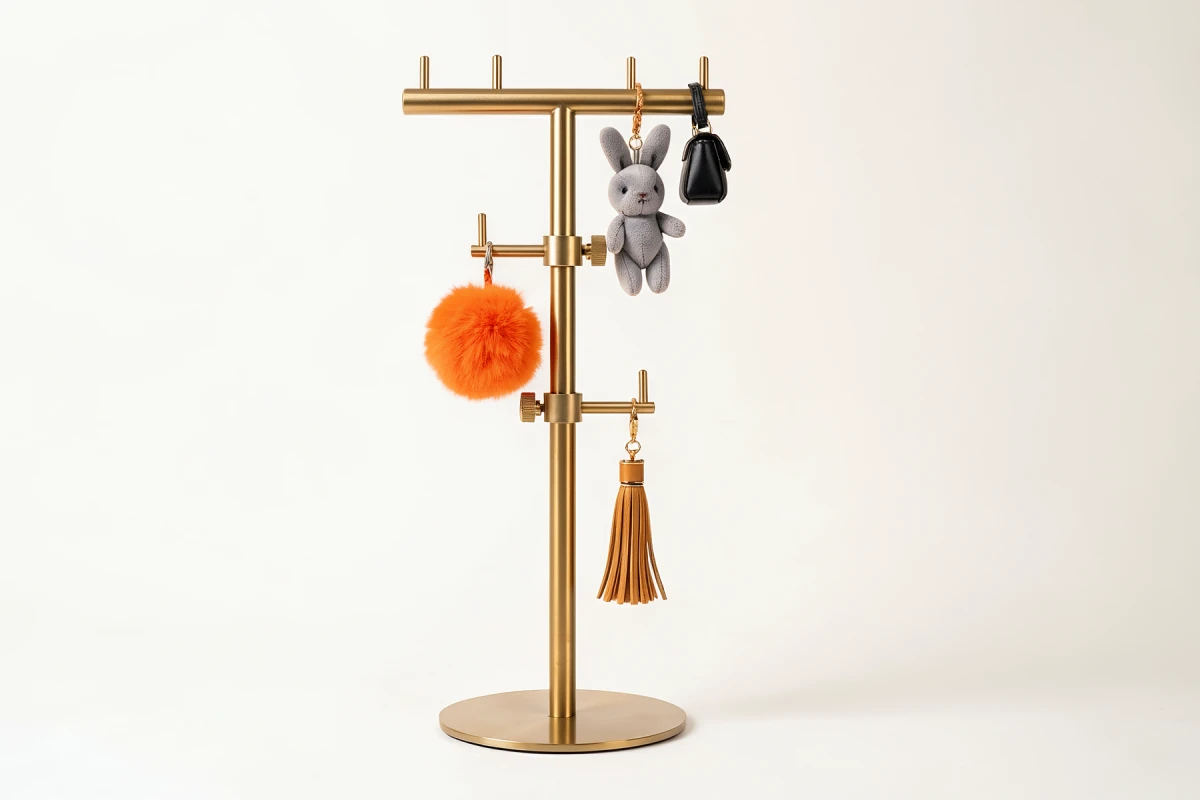
“Can they also come off if or when not needed?”
That question arrived mid-project, from the accessories lead at an Australian womenswear brand (name withheld for privacy). At that point the stand existed only as a drawing.
She had been buying from us for two years, and her first email on the subject was the way a regular opens: “we are just loving our shoe inserts and bag stands in store.”
Then came the reason for writing. “A new category of accessories launching in a few months.”
She thought she needed something for belts. By the time the category firmed up, it had become bag charms: short, light, sold in small clusters, each one hanging from a clasp smaller than a fingertip.
A bag charm is not a bag. Every display stand already in her stores had been designed around one.
Why a Bag Stand Cannot Hold a Bag Charm
A handbag stand is a set of assumptions bent into metal. The hook is long enough for a rolled handle. The space between two hooks is the width of a bag. The tier heights sit where a bag body reads from the doorway.
A bag charm breaks all three at once. Four on one hook bunch into a knot. One on its own disappears beside the pole. Laying a row flat on a shelf does not help either: it sits under the band that gets attention, which eye-tracking work puts lower than most people assume.
Her requirements pulled in two directions at once. The charms had to read from a meter away and lift off without disturbing the one next to them. The fixture also had to look like part of the store’s own prop set rather than a length of hardware bought in for the occasion. Her summary came in one sentence:
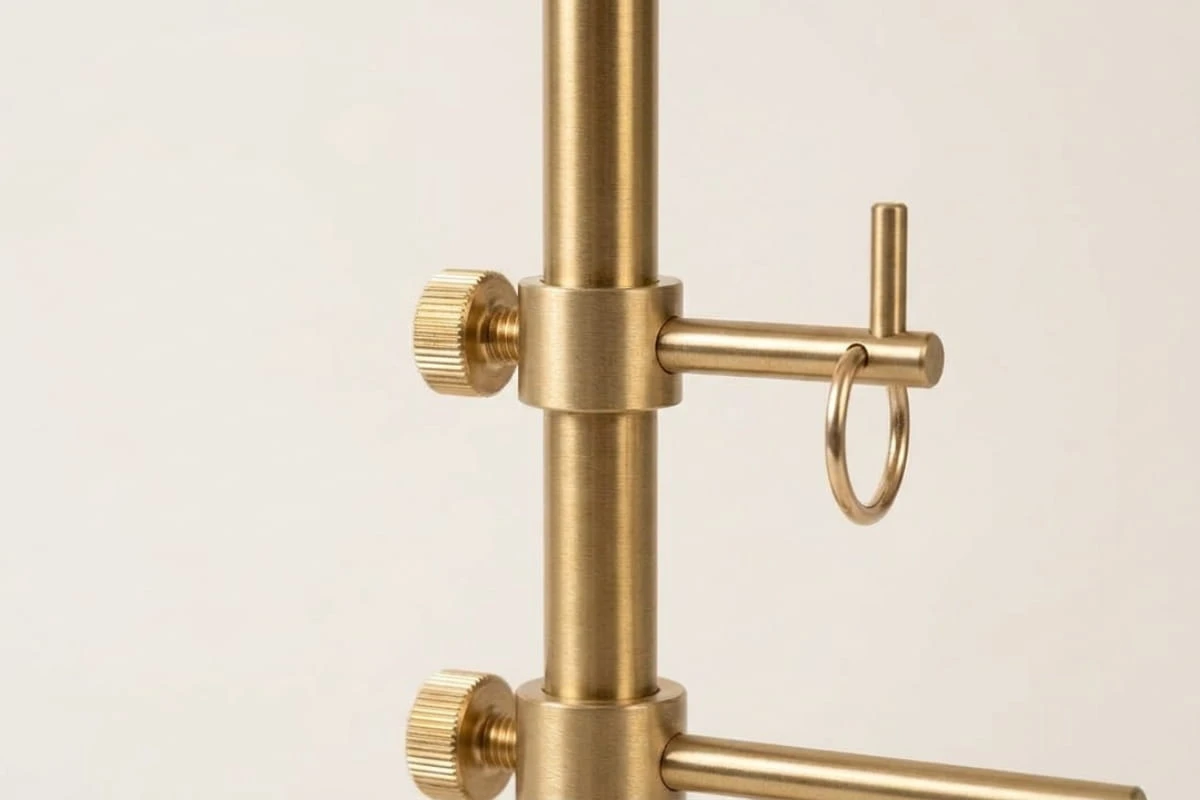
“I don’t love the look of the screws.”
That sentence shaped more of the design than any drawing we sent.
The Drawing Was Approved Without Its Most Important Number
We started with drawings rather than samples: one 3D model to show the stand sitting in a room, one 2D sheet carrying the dimensions. A few rounds later her reply arrived. “I am happy with this new design, it looks great.”
With one condition attached. “I am just confirming the ideal length of the prongs this afternoon.”
The order of work is in those two sentences. The design was signed off while the dimension that decides everything was still open. That sounds backwards, and it is the part of this project worth copying. A prong’s length sets whether a charm hangs proud of the pole or lies flat against it, and the answer lives in the product, not in the fixture. A number filled in for the drawing’s sake would have produced a clean file and a wrong sample.
So she took her own charms and measured.
While that was open, the rest of the spec firmed up: four fixed hooks across the top, two single hooks below, 40cm of total height, and a round base of 15 to 18cm.
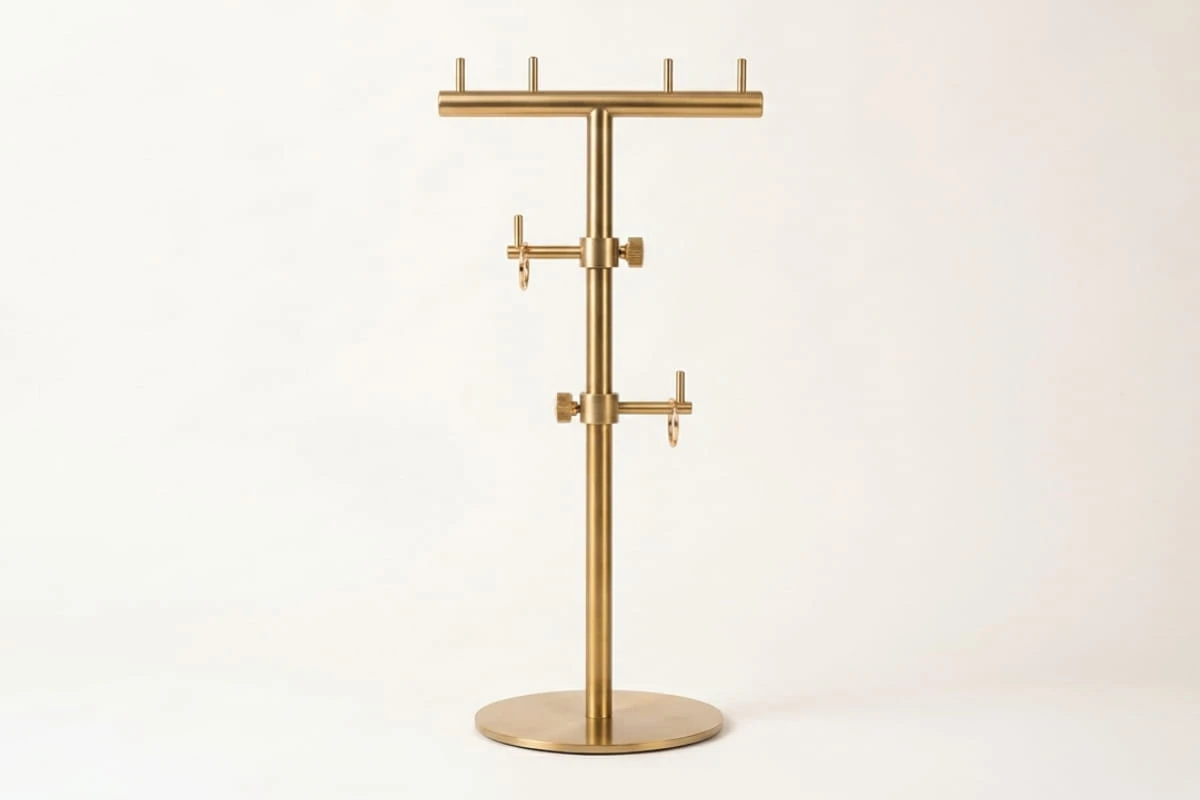
The lowest hook lands at the top of the fixed lower run, about 20cm up. That keeps the bottom of the pole solid, with no slots for a clasp to catch on.
The 40cm was her number, not ours. We had proposed 50cm, the safe height for a bag stand, and she turned it down because “the bag charms aren’t super long”. She was right: a 50cm pole carrying product this short spends most of its height showing nothing.
The diameter stayed a range rather than a fixed number: “will test to stand well.” The sample went out with it still open, so the base could be settled with charms hanging on it instead of in a drawing.
Five decisions sat behind that spec.
“Can They Also Come Off?”
Removable hooks get sold as flexibility. In a store they are a calendar: the assortment turns over with the season, and a fixture that cannot turn with it ends up in the stockroom. Both lower hooks come off.
“I Don’t Love the Look of the Screws”
A square tube is easier to weld and closes up cleanly. We flagged what it would not fix: a sliding hook needs a fixing, and the fixing is on show. She took the round pole anyway. Explaining an engineering limit does more for a client than deciding for them.
A Base Size Is Not a Drawing Question
A base size for a light product is a physical question, and a drawing cannot test what is standing on it. If a supplier gives you an exact diameter for a new product type before seeing the product, the number came from somewhere other than your merchandise.
The Height Came From the Charms
Heights get copied from whichever category a fixture is modeled on. The catalogue carries the whole scale: the two-hook tie stand runs 48 to 79cm because ties hang that far, and a charm needs a fraction of it. Ask what the product measures before a drawing borrows a number.
The Bottom Section Stays Solid
An adjustable joint is also a gap. Keeping the lower run closed, with every slot above it, leaves fewer places for a clasp to catch and a cleaner line from the doorway.
Six Stores, One Fixture Suite
The charm stand was never a single item. The same order covered about six new stores opening in the same year, with the accessory fixtures going in together, and that changes what “approved” means. A stand that works in one store can look borrowed in the sixth. The same failure has a case study of its own: a jewelry brand whose three stores read as three different companies, because every fixture had been bought separately (read that case).
So the order also moved her two-arm bag stands from a square base to a round one. Her reason, in her words: “ensure perfect unison across our fixture suite.” A base profile stops being a detail when six stores are photographed for the same brand account.
Quantity was settled in a line: “happy to proceed with the right qty to ensure we lock in production.”
The order it was built for went ahead, and the first of those stores was due to open in May.
On a rollout, the spec is the cheapest part of the work and the first to drift between store two and store six. Fix finish, base and hook count once, before the first purchase order.
The Same Three Questions for the Next Category
Belts started the conversation, and they are back on the table now. The shapes differ in one way worth knowing before the drawing starts: a belt wants a C-hook it can drop into, and a charm wants a prong it can slide onto. Everything else we learned about charms carried over.
She asked for a belt sample in any finish to trial her own stock on it, and once the samples land she plans to put two shapes in front of her CEO. If either is approved, she wants it in a circular base and brushed gold across the group, roughly two fixtures per store and about 120 pieces.
Has anyone measured the product? Not the category, the actual item: drop length, thickness, and how the clasp or buckle behaves when it hangs free. A charm measured lying flat is not the same object as one hanging from its clasp.
How many tiers are fixed and how many adjust? A stand where everything adjusts is a stand that never quite settles. Fix the top, tune the middle, leave the bottom of the pole solid.
Has the base been tested with product on it? Light products tip small fixtures. Stability gets settled with the real thing standing on a counter, not with a drawing. Ask for the test, and ask what was on the base when it happened.
Those three questions do not change for scarves, keyrings or lanyards.
Where to Start
If a new category lands in a few months, the fixture work starts earlier than the buying. Send us the product, or a photo and its measurements, and you will get a 3D and a 2D back. Start with the handbag and purse display range for this kind of stand, or the accessories display range for belts, eyewear, ties or small leather goods. Or write to us with the product in hand.
Every fixture in that order started the same way: a drawing, a sample, and a client who had already measured her own product.
References
Chen, M., Burke, R. R., Hui, S. K., & Leykin, A. (2021). Understanding lateral and vertical biases in consumer attention: An in-store ambulatory eye-tracking study. Journal of Marketing Research, 58(6), 1120 to 1141.