
 EN
 ES
 FR
 DE
 IT
 PT
 AR
 JA
Stainless Steel for Display Fixtures: Grades and Finishes
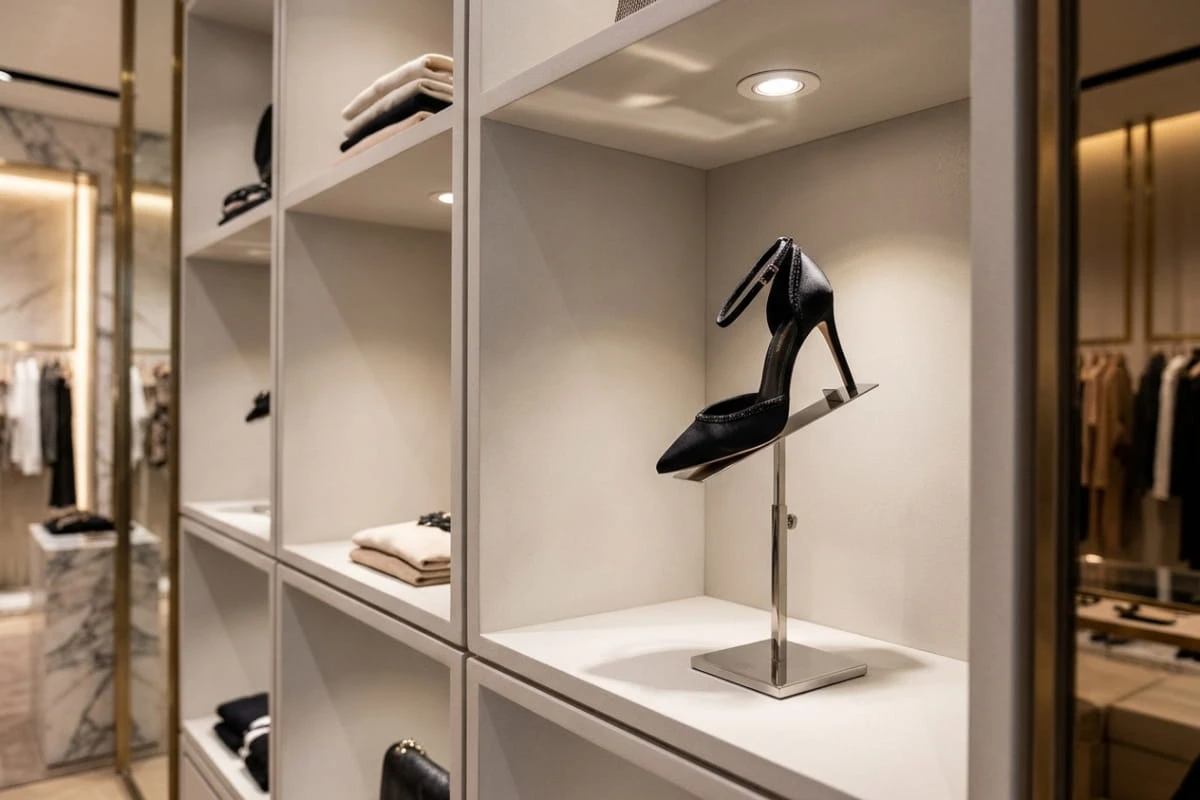
Two quotes for the same display stand, one at 201 brushed and one at 304 mirror. The difference is real, and nickel prices only explain part of it. What those two lines describe is how the fixture will look in two years.
The short version we give buyers before they sign: take 304 unless the fixture is indoor and the budget is the whole conversation. Put brushed metal anywhere a hand goes. And treat a finish code as a method rather than a promise, because two sheets carrying the same code can end up looking different.
Grade: What 201 and 304 Differ On
| 201 | 304 | 316 | |
|---|---|---|---|
| Chromium | 16.0-18.0% | 18.0-20.0% | 16.0-18.0% |
| Nickel | 3.5-5.5% | 8.0-10.5% | 10.0-14.0% |
| Manganese | 5.5-7.5% | 2.0% max | 2.0% max |
| Molybdenum | none | none | 2.0-3.0% |
201 exists to use less nickel, with manganese and nitrogen holding the crystal structure nickel would otherwise hold. It costs less and it resists chlorides worse.
The decision is the environment, not the datasheet. Indoor, temperate, a fixture that mostly stands still: 201 will see the shop out. Coastal air, a chemical wipe-down every morning, an outdoor poster stand at a restaurant door: 201 shows tea staining at the welds and feet long before anyone planned to replace it.
Here is the part buyers dislike. You cannot check it at goods-in. 201 is non-magnetic, so the magnet that separates a 430 pan from a 304 one tells you nothing here. ASSDA says the same: these grades look stainless from day one and are “often assumed to be 304 or even 316”. Ask for the mill certificate.
316 solves for chlorides, not for quality. Two or three percent molybdenum, a pitting resistance equivalent around Cr + 3.3Mo + 16N, and it earns its price on a seafront patio rather than in a jewellery case.
The Finish Code Names the Method
2B, BA, No.4, No.8 get read as grades of quality. They are process routes, and EN 10088-2 is explicit that the codes describe how the surface was made rather than a measured surface (BSSA).
| Code (EN) | Code (ASTM) | How it is made | Typical Ra |
|---|---|---|---|
| 2D | 2D | Cold rolled, annealed, pickled | 0.4-1.0 µm |
| 2B | 2B | Cold rolled, annealed, pickled, skin passed | 0.1-0.5 µm |
| 2R | BA | Cold rolled, bright annealed | 0.05-0.1 µm |
| 2J | No.4 | Brushed or dull polished, unidirectional | 0.2-1.5 µm |
| 2K | No.6 | Satin polished | under 0.5 µm |
| 2P | No.8 | Bright polished, mirror | under 0.1 µm |
2B is what arrives when nobody specifies anything. No.4 is the brushed face most retail fixtures wear. No.8 is the mirror. BA sits between them, bright but carrying a milky cast rather than a true reflection (Vulcan).
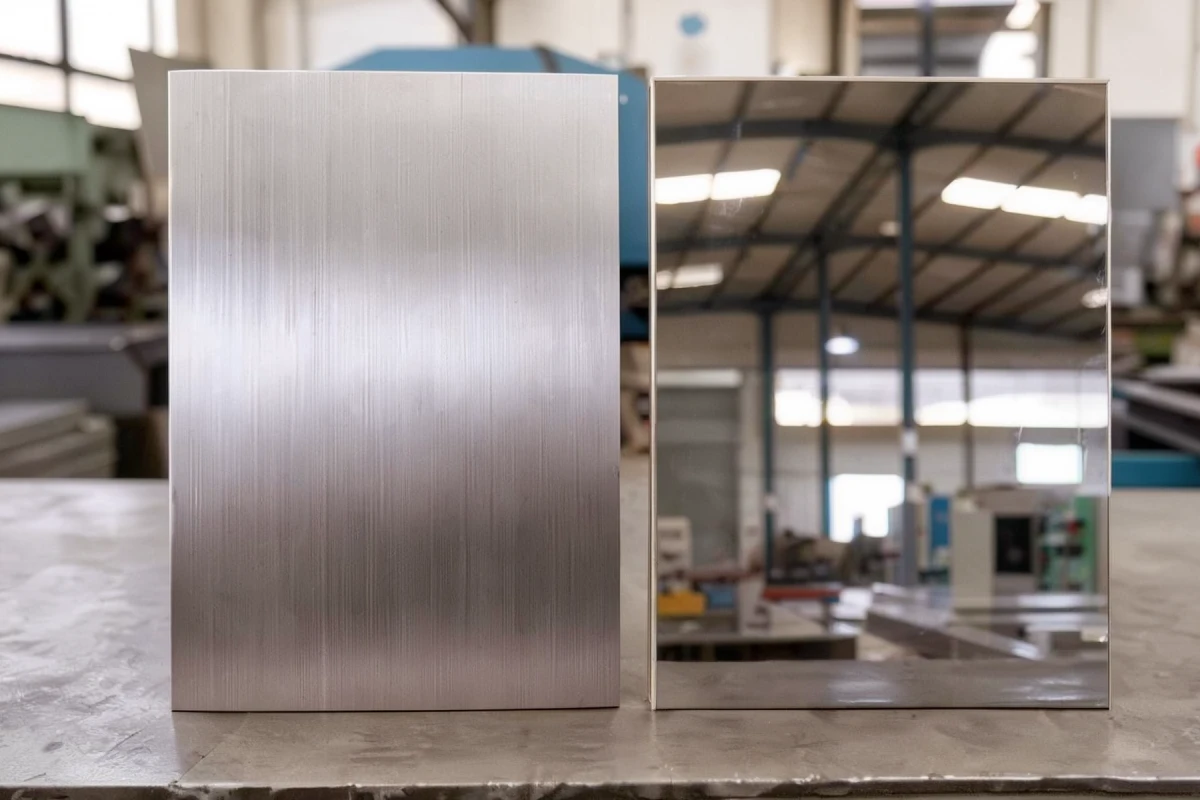
The code does not guarantee the look. worldstainless.org states that products with identical designations from different batches or suppliers “may have noticeably different roughness characteristics”. One run of fixtures looks uniform on the rack. Two runs together do not, and you find that out under store lighting with the client beside you. Ra settles it: average roughness height in micrometres, lower is smoother, and the figures above are indicative rather than guaranteed.
HL is not one of the standard codes. EN 10088-2 defines G, J, K and P, and BSSA warns that finishes described as “satin”, “polished”, “dull”, “bright” or “mirror” “can vary quite significantly between mechanical finishing contractors”. A drawing that says hairline has specified a word.
Brushed Survives a Shop Floor, Mirror Doesn’t
The choice gets made on aesthetics and then fails on maintenance.
BSSA is unusually direct here. Brushed finishes “are susceptible to damage, but scratches can be readily abraded out”, and they “do not fingerprint easily and therefore can be used successfully in areas of high contact”. Reflective surfaces take damage too, and remedial polishing “is possible but it is more difficult to get satisfactory results than on non-reflective finished surfaces”.
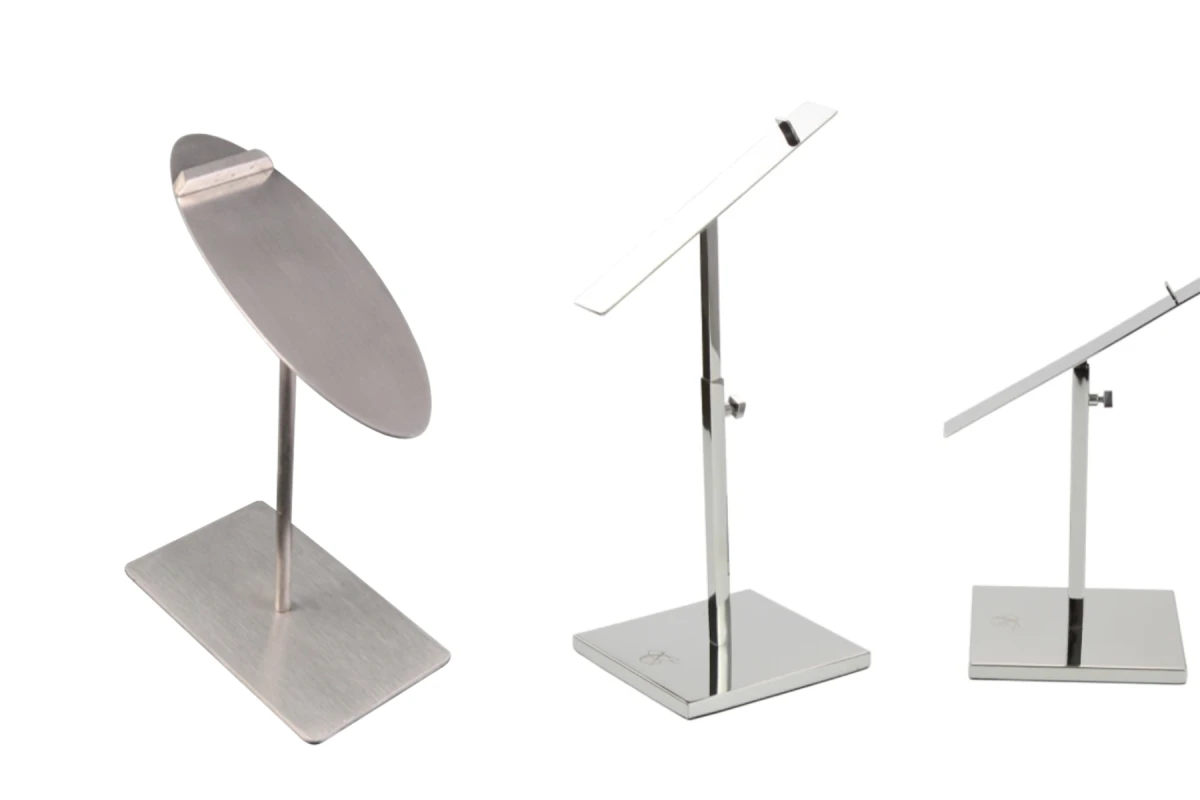
Over three years of store traffic that decides what the fixture looks like far more than the day-one photographs do. A scuff on a brushed shoe riser comes out in the back room with the right pad. On the mirror version the same damage has to be polished and blended, blending is the thing a polisher will not promise you, and in practice the part gets replaced or the scratch stays.
Mirror is also the finish that shows the seam between two polishers, which is why a mirror batch has to come from one shop and one run.
So mirror goes where the panel is fixed, behind a counter, and nobody touches it. Brushed goes on everything else.
What a Finish Cannot Hide
Whatever is applied to a fixture is thin, and thin means it reports on everything under it.
A decorative coating runs about 0.2 to 1 µm, and BSSA notes that at that thickness “the texture of the underlying finish is visible”. An uneven polish stays visible as an uneven fixture, and the customer blames the surface rather than the work beneath it.
Welds behave the same way. Argon arc welding leaves a bead, a heat-affected zone and often a tint, and tint left in place prints through a mirror and clouds a coat. On brushed metal the grain also has to be laid back in the same direction as the surrounding steel, or the joint reads as a patch under every light in the shop.
Most of the rust that appears months later went in at the bench. BSSA traces contamination staining on polished stainless to finishing media and hand tools previously used on carbon steel, and calls multi-metal fabrication shops a particular risk. Iron pushed into the surface at that stage does not come out with a cloth.
The expensive part of a fixture is finished before the finish goes on. You are not buying a coat that will cover the work, you are buying work a coat will survive.
What It Comes Down To
Two things do most of the work on a drawing. The grade, in writing, with a mill certificate behind it. And a physical sample of the finish that the run was approved against. Everything else can be argued from a photograph.
We build these in 201 and 304, brushed or mirror, and powder coated where a colour is needed. The clothing display line is where buyers most often weigh stainless against powder-coated iron, and the same reasoning applies across the catalog. If two quotes differ on grade or finish, send both and we will tell you which line is carrying the price.
References
ASSDA. 200 series stainless steels - high manganese (CrMn). Australian Stainless Steel Development Association.
British Stainless Steel Association. Colouring stainless steel.
British Stainless Steel Association. Specifying finishes for stainless steel flat products (sheet and plate).
British Stainless Steel Association. Specifying mechanically polished, brushed and buffed stainless steel finishes and their applications.
Vulcan. Surface finishes: stainless flat products.
worldstainless.org. Roughness measurements of stainless steel surfaces.